Preprint · Not Peer Reviewed
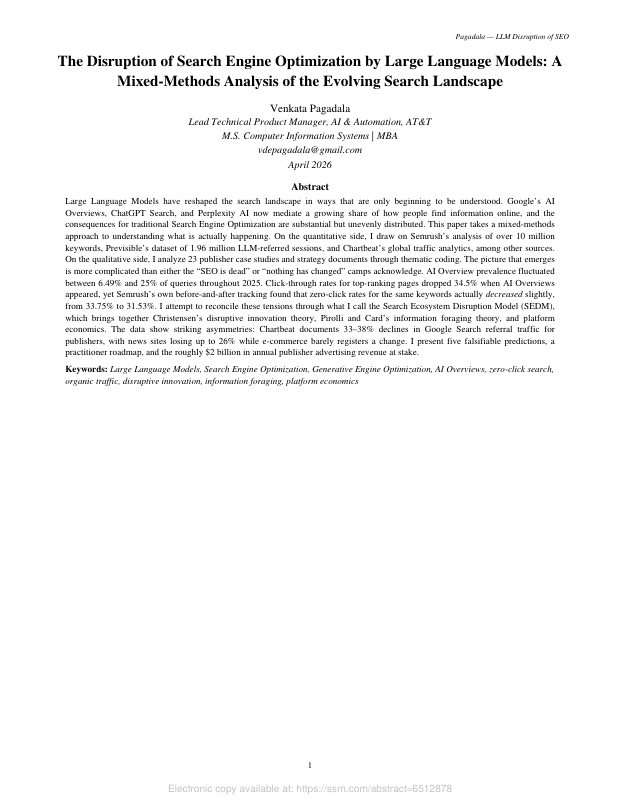
SSRNThe Disruption of Search Engine Optimization by Large Language Models: A Mixed-Methods Analysis of the Evolving Search Landscape
SSRN · 9 pages · Posted 17 Apr 2026
Venkata Pagadala · Independent Researcher
Date written: April 3, 2026
Abstract
Large Language Models have reshaped the search landscape in ways that are only beginning to be understood. Google's AI Overviews, ChatGPT Search, and Perplexity AI now mediate a growing share of how people find information online, and the consequences for traditional Search Engine Optimization are substantial but unevenly distributed. This paper takes a mixed-methods approach to understanding what is actually happening. On the quantitative side, I draw on Semrush's analysis of over 10 million keywords, Previsible's dataset of 1.96 million LLM-referred sessions, and Chartbeat's global traffic analytics, among other sources. On the qualitative side, I analyze 23 publisher case studies and strategy documents through thematic coding. The picture that emerges is more complicated than either the "SEO is dead" or "nothing has changed" camps acknowledge. AI Overview prevalence fluctuated between 6.49% and 25% of queries throughout 2025. Click-through rates for top-ranking pages dropped 34.5% when AI Overviews appeared, yet Semrush's own before-and-after tracking found that zero-click rates for the same keywords actually decreased slightly, from 33.75% to 31.53%. I attempt to reconcile these tensions through what I call the Search Ecosystem Disruption Model (SEDM), which brings together Christensen's disruptive innovation theory, Pirolli and Card's information foraging theory, and platform economics. The data show striking asymmetries: Chartbeat documents 33-38% declines in Google Search referral traffic for publishers, with news sites losing up to 26% while e-commerce barely registers a change. I present five falsifiable predictions, a practitioner roadmap, and the roughly $2 billion in annual publisher advertising revenue at stake.
JEL classification: L86, M37, O33, L13
Suggested citation
Pagadala, Venkata, The Disruption of Search Engine Optimization by Large Language Models: A Mixed-Methods Analysis of the Evolving Search Landscape (April 3, 2026). Available at SSRN: ssrn.com/abstract=6512878 or doi.org/10.2139/ssrn.6512878