The AI Notebook · 2026 Edition
Free AI Roadmap 2026
Your complete AI learning companion, from zero to hero. A roadmap with 473+ curated resources (93% free), 187 concepts explained, and 100 contributors profiled.
Last reviewed August 2026. Every profile, every link and every definition checked by hand, not assumed.

Venkata Pagadala
Curator
AI Product & Research. Search, SEO, GEO & Automation at enterprise level. 10M+ pages managed.
18K+
Followers
404K+
Impressions
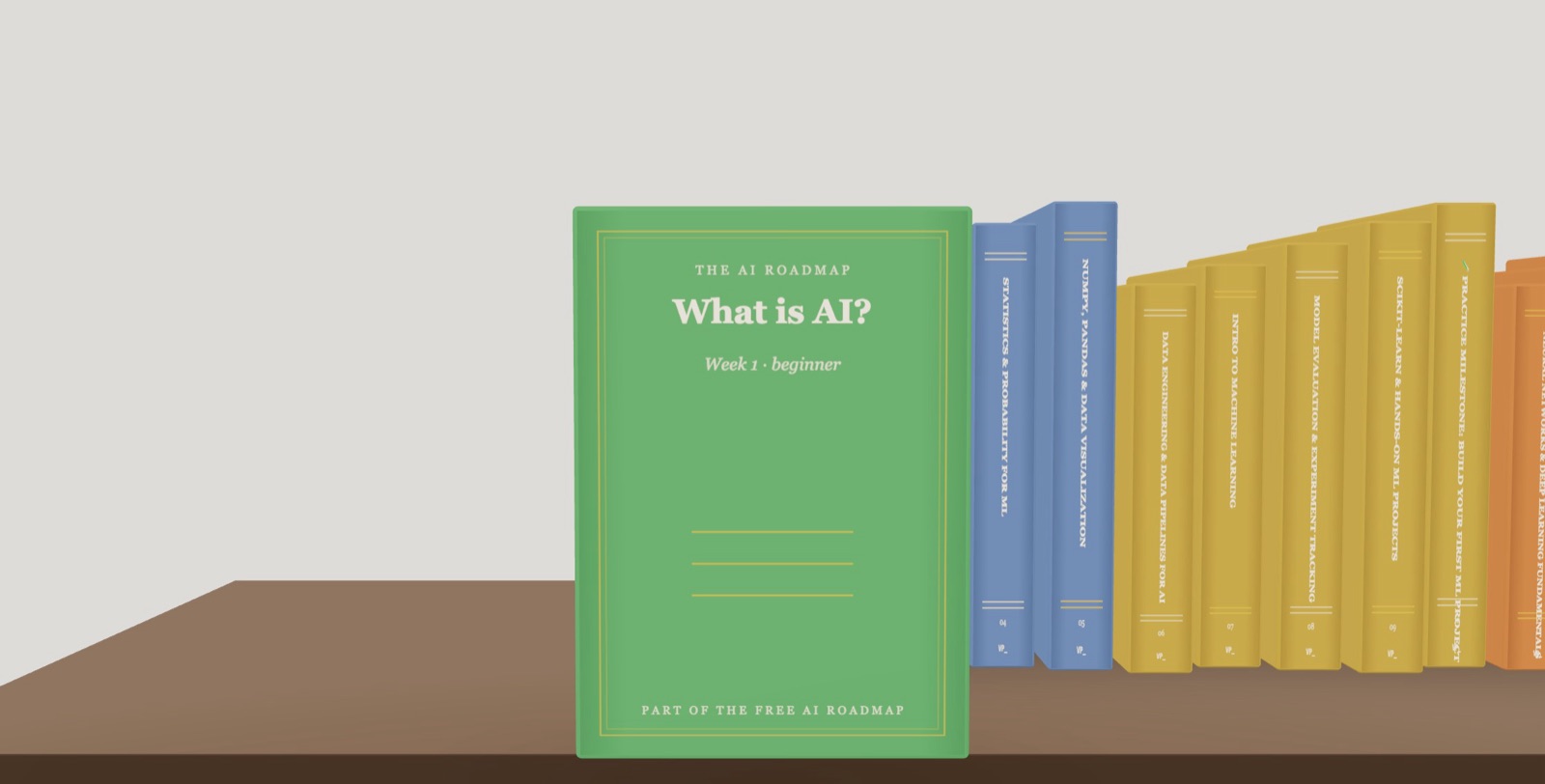
The AI Roadmap, as a shelf
every volume is a topic · click a spine
🗺️ Free AI Roadmap, Zero to Hero · August 2026
A structured AI curriculum with 473 curated resources: videos, courses, books, repos, and pro tips. 93% are completely free. Every link was opened and checked, July and August 2026 passes.
32
Topics
127+
Videos
134+
Courses
119+
Repos
93+
Books
3
Milestones
Understand what Artificial Intelligence actually is, its history, different types (narrow vs general AI), and where it's headed. Get the mental map before diving into code.
Best Videos (4)
Courses & Sites (5)
Books & Papers (1)
Tools: ChatGPT, Claude, Google Gemini, try using AI first to understand what it can do before learning how it works
Don't jump into code yet. Spend Week 1 just understanding the landscape. Watch videos, read articles, and form your own mental model of what AI is and isn't.
Key Contributors
Python is THE language for AI/ML. Learn core Python: variables, loops, functions, classes, list comprehensions, file I/O. You don't need to be an expert, just comfortable enough to write and read code.
Best Videos (4)
Courses & Sites (4)
Books & Papers (1)
Tools: VS Code, Google Colab (free GPU!), Jupyter Notebooks, Replit
Focus on: lists, dictionaries, functions, loops, and classes. Practice on LeetCode Easy or HackerRank. Google Colab is your best friend, free, browser-based, no setup needed. And if you are weighing Python against R: Python won for AI and production systems, R remains lovely for pure statistics.
Related Concepts
Key Contributors
You need just enough math to understand what's happening inside ML models. Key concepts: vectors, matrices, matrix multiplication (linear algebra), derivatives and gradients (calculus). You do NOT need a math degree.
Best Videos (4)
Courses & Sites (4)
Books & Papers (3)
Tools: NumPy (practice matrix ops in code), Desmos (graph visualizer), GeoGebra, Wolfram Alpha
Don't get stuck here for months. Spend 1-2 weeks getting the intuition from 3Blue1Brown videos, then move on. You'll reinforce the math naturally as you code ML models. Intuition > memorization.
Key Contributors
Core statistics you'll need: distributions (normal, uniform), mean/median/mode, standard deviation, correlation, hypothesis testing, Bayes' theorem, probability basics. These concepts underpin every ML algorithm.
Best Videos (4)
Courses & Sites (4)
Books & Papers (2)
Tools: SciPy (scipy.stats), statsmodels, Seeing Theory (interactive visualizations)
StatQuest on YouTube is the single best resource for statistics. Josh Starmer explains everything with humor and clarity. Watch his playlists before touching any textbook.
Related Concepts
Key Contributors
The essential Python data stack. NumPy for numerical computing and arrays, Pandas for data manipulation and analysis, Matplotlib/Seaborn for visualization. These are used in every single ML project.
Best Videos (4)
Courses & Sites (4)
Books & Papers (3)
Tools: Google Colab, Jupyter Notebooks, Kaggle Notebooks (free GPU), VS Code with Python extension
Download a real dataset from Kaggle and play with it. Load it in Pandas, explore with .head(), .describe(), .value_counts(). Plot charts. This hands-on experience is worth more than 10 tutorials.
Related Concepts
Real AI projects need real data pipelines. Learn data cleaning, missing value handling, feature scaling, encoding categorical variables, data augmentation, SQL basics, and working with APIs. Garbage in = garbage out, data quality is 80% of ML success.
Best Videos (4)
Courses & Sites (4)
Books & Papers (1)
Tools: Pandas, SQL (PostgreSQL, SQLite), Apache Airflow, dbt, Great Expectations, ydata-profiling
Data scientists spend 60-80% of their time on data preparation. Master Pandas deeply: .merge(), .groupby(), .pivot_table(), .apply(), handling missing values with .fillna() and .interpolate(). Learn basic SQL, most ML data comes from databases.
Related Concepts
The core ML concepts: supervised vs unsupervised learning, regression, classification, train/test splits, overfitting, bias-variance tradeoff. This is where everything comes together, your Python, math, and data skills meet ML algorithms.
Best Videos (4)
Courses & Sites (4)
Books & Papers (2)
Tools: scikit-learn (primary ML library), Google Colab, Kaggle (start competing!), Weights & Biases (experiment tracking)
Start with scikit-learn, NOT TensorFlow/PyTorch. Build simple models first: Linear Regression → Logistic Regression → Decision Trees → Random Forest. Do Kaggle's Titanic competition, it's the Hello World of ML.
How do you know if your model is actually good? Learn evaluation metrics (accuracy, precision, recall, F1, AUC-ROC, RMSE, MAE), confusion matrices, learning curves, cross-validation, A/B testing, and experiment tracking with MLflow/W&B.
Best Videos (4)
Courses & Sites (4)
Books & Papers (2)
Tools: scikit-learn metrics, Weights & Biases, MLflow, TensorBoard, Optuna (hyperparameter tuning)
NEVER just use accuracy, it's misleading for imbalanced datasets. Learn when to use precision vs recall (hint: false positives vs false negatives have different costs). Start tracking experiments from day 1 with Weights & Biases, it's free for individuals.
Key Contributors
Get hands dirty with real ML projects. Learn the scikit-learn workflow: load data → preprocess → feature engineering → model selection → train → evaluate → tune hyperparameters. Practice on real Kaggle competitions.
Best Videos (4)
Courses & Sites (4)
Books & Papers (2)
Tools: scikit-learn, XGBoost, LightGBM, Kaggle Notebooks, Weights & Biases, Optuna (hyperparameter tuning)
Do at least 3 Kaggle competitions: Titanic (classification), House Prices (regression), and one tabular playground. Read winning solutions, they teach you more than any course.
Key Contributors
STOP and BUILD. Don't move to Deep Learning until you've completed at least 2 hands-on projects. This is where most learners fail, they watch videos endlessly but never code. Build a complete ML pipeline from scratch: data collection → EDA → feature engineering → model training → evaluation → deployment.
Best Videos (4)
Courses & Sites (4)
Books & Papers (1)
Tools: Kaggle Notebooks, Google Colab, Streamlit, Gradio, scikit-learn
MUST-DO: ① Titanic Survival Prediction (classification) ② House Price Prediction (regression) ③ Customer Churn Analysis (real business problem) ④ Build a web app with Streamlit showing your model.
The jump from classical ML to deep learning. Understand neurons, layers, activation functions, forward/backward propagation, loss functions, and gradient descent. This is the foundation for everything modern in AI, from ChatGPT to self-driving cars.
Best Videos (4)
Courses & Sites (4)
Books & Papers (3)
Tools: PyTorch (recommended), TensorFlow/Keras, Google Colab (free GPU), Weights & Biases
Start with 3Blue1Brown's 4-part neural network series, it gives you the visual intuition that textbooks can't. Then move to fast.ai which teaches top-down (build working models first, understand theory after). Choose PyTorch over TensorFlow for learning.
Key Contributors
PyTorch is the #1 deep learning framework used in research and increasingly in production. Learn tensors, autograd, building models with nn.Module, training loops, data loaders, and GPU acceleration.
Best Videos (4)
Courses & Sites (4)
Books & Papers (3)
Tools: PyTorch, PyTorch Lightning, Google Colab (free GPU/TPU), Weights & Biases (experiment tracking), Hugging Face (model hub)
Andrej Karpathy's 'Neural Networks: Zero to Hero' playlist is the single best resource for learning deep learning from scratch. He builds everything from raw Python, no library shortcuts. Watch it all.
Related Concepts
Key Contributors
Convolutional Neural Networks (CNNs) are how AI 'sees'. Learn convolution operations, pooling, classic architectures (LeNet, AlexNet, VGG, ResNet), transfer learning, and image classification/detection/segmentation.
Best Videos (4)
Courses & Sites (4)
Books & Papers (2)
Tools: torchvision, OpenCV, Albumentations, Roboflow (data labeling), Hugging Face (pretrained models)
Don't build from scratch, use transfer learning. Take a pretrained ResNet or EfficientNet from torchvision, freeze early layers, fine-tune on your data. You'll get 95%+ accuracy on most image tasks with very little data.
Key Contributors
Recurrent Neural Networks process sequential data, text, time series, audio. Learn vanilla RNNs, the vanishing gradient problem, LSTMs, GRUs, and seq2seq models. These were the foundation before Transformers took over.
Best Videos (4)
Courses & Sites (4)
Books & Papers (3)
Tools: PyTorch (nn.LSTM, nn.GRU), TensorFlow/Keras, Google Colab
RNNs/LSTMs are largely being replaced by Transformers, but understanding them is crucial for the historical context and for time-series problems where they still shine. Read Chris Olah's LSTM blog post, it's the best explanation ever written.
Related Concepts
Key Contributors
THE architecture that changed everything. Understand self-attention, multi-head attention, positional encoding, encoder-decoder structure. Transformers power GPT, BERT, Claude, Stable Diffusion, and nearly all modern AI.
Best Videos (5)
Courses & Sites (4)
Books & Papers (3)
Tools: Hugging Face Transformers, PyTorch, Google Colab, Weights & Biases
This is the most important topic in modern AI. Karpathy's 'Let's build GPT from scratch' video (2hrs) is THE best way to learn it, he codes a working GPT character by character. Pair it with Jay Alammar's Illustrated Transformer blog post for the visual intuition.
Related Concepts
Key Contributors
BUILD before moving to NLP. Complete at least 2 deep learning projects: one in computer vision and one sequence/text task. Deploy at least one model as a live web app. This proves you can actually ship, not just watch tutorials.
Best Videos (4)
Courses & Sites (4)
Books & Papers (1)
Tools: PyTorch, Hugging Face Spaces, Gradio, FastAPI, Docker, Google Colab
MUST-DO: ① Image classifier with transfer learning ② Text sentiment analyzer using RNNs or fine-tuned BERT ③ Neural network from SCRATCH ④ Deploy one project to Hugging Face Spaces.
Natural Language Processing, how AI understands text. Learn tokenization, word embeddings (Word2Vec, GloVe), text preprocessing, sentiment analysis, named entity recognition, and text classification. The stepping stones to LLMs.
Best Videos (4)
Courses & Sites (4)
Books & Papers (3)
Tools: Hugging Face, spaCy, NLTK, Google Colab, Kaggle
Start with Hugging Face's free NLP course, it's practical and modern. spaCy is the go-to library for production NLP. For learning, the Stanford CS224n lectures are unmatched in depth.
Key Contributors
Before building LLMs, learn to USE them expertly. Prompt engineering is the #1 most practical AI skill in 2025-2026. Learn zero-shot, few-shot, chain-of-thought, ReAct prompting, system prompts, structured outputs, and how to get consistent, reliable results from any LLM.
Best Videos (4)
Courses & Sites (5)
Books & Papers (3)
Tools: Claude, ChatGPT, Gemini, Anthropic Workbench, OpenAI Playground, Prompt IDE tools
The most underrated AI skill. Start with Anthropic's prompt engineering guide, it's the best practical resource. Key techniques: (1) Be specific and structured (2) Use XML tags (3) Chain-of-thought for reasoning (4) Few-shot examples (5) System prompts. Practice daily.
The era of LLMs. Understand how GPT, BERT, Claude, Llama, and other LLMs work. Learn pre-training, fine-tuning, prompt engineering, RLHF, in-context learning, emergent abilities, and the scaling laws that make them powerful.
Best Videos (6)
Courses & Sites (4)
Books & Papers (5)
Tools: Hugging Face, Ollama (run local LLMs), OpenAI API, Anthropic API, LangChain, vLLM
Karpathy's LLM intro talk is the best 1-hour overview that exists. Then try running a model locally with Ollama (literally one command). Understanding how to USE LLMs well (prompt engineering) is just as important as understanding how they work internally.
Make LLMs work for YOUR use case. Learn fine-tuning (LoRA, QLoRA), Retrieval-Augmented Generation (RAG), vector databases, embeddings, prompt engineering patterns, and building LLM-powered applications.
Best Videos (4)
Courses & Sites (5)
Books & Papers (2)
Tools: LangChain, LlamaIndex, ChromaDB, Pinecone, Weaviate, Hugging Face PEFT, Ollama, OpenAI API
RAG is the most practical skill for 2025-2026. It lets you connect LLMs to your own data without expensive fine-tuning. Start by building a simple RAG app: embed your documents in ChromaDB, retrieve relevant chunks, pass to an LLM. LangChain or LlamaIndex make this easy.
Related Concepts
Key Contributors
The capstone practice before specializing. Build a complete LLM-powered application: a RAG chatbot, an AI agent, a document Q&A system, or a writing assistant. Deploy it live. This is the project that gets you hired in 2025-2026.
Best Videos (4)
Courses & Sites (4)
Books & Papers (2)
Tools: LangChain, LlamaIndex, ChromaDB, Streamlit, Gradio, Hugging Face Spaces, Vercel, Railway
MUST-DO: ① Document Q&A Bot, Upload PDFs, ask questions (RAG) ② AI Writing Assistant, Custom persona + style ③ Multi-tool AI Agent, Can search web, run code, analyze data ④ Deploy to Hugging Face Spaces or Vercel for a live demo URL.
Beyond text: learn how AI generates images (Stable Diffusion, DALL-E), audio (speech synthesis, music), and video. Understand diffusion models, GANs, VAEs, and the creative AI revolution.
Best Videos (4)
Courses & Sites (4)
Books & Papers (3)
Tools: Stable Diffusion, ComfyUI, DALL-E, Midjourney, Runway ML, Whisper (speech-to-text)
Diffusion models have largely replaced GANs for image generation. Start by running Stable Diffusion locally with ComfyUI, it's the best way to understand the generation pipeline. For audio, OpenAI's Whisper is incredibly good and open-source.
Related Concepts
Key Contributors
The hottest frontier in AI (2025-2026). AI agents can plan, use tools, browse the web, write code, and complete multi-step tasks autonomously. Learn agent architectures, tool use, memory systems, ReAct pattern, and frameworks like LangGraph and CrewAI.
Best Videos (4)
Courses & Sites (9)
Books & Papers (3)
Tools: LangGraph, CrewAI, AutoGen, Claude with tool use, OpenAI Assistants API, Anthropic Claude Agent SDK
AI Agents are where the industry is moving in 2025-2026. Start by building a simple ReAct agent with LangGraph, give an LLM access to a calculator and web search, watch it reason and act. Then build something real: a research agent, a coding assistant, or a data analysis agent.
Key Contributors
Getting models from notebook to production. Learn model serving (FastAPI, Flask), containerization (Docker), model monitoring, CI/CD for ML, experiment tracking, and cloud deployment (AWS, GCP, Azure).
Best Videos (4)
Courses & Sites (4)
Books & Papers (2)
Tools: Docker, FastAPI, Gradio, Streamlit, MLflow, Weights & Biases, Hugging Face Spaces, AWS SageMaker, GCP Vertex AI
Build a portfolio project end-to-end: train a model, wrap it in FastAPI, containerize with Docker, deploy to Hugging Face Spaces or Railway. Gradio and Streamlit are the fastest ways to create a shareable demo. Chip Huyen's MLOps book is essential reading.
Related Concepts
Key Contributors
Go deeper into RL: Q-learning, Deep Q-Networks (DQN), Policy Gradients, PPO, Actor-Critic methods, and RLHF (how ChatGPT was trained). RL is key to robotics, game AI, and aligning LLMs.
Best Videos (4)
Courses & Sites (4)
Books & Papers (4)
Tools: Gymnasium (OpenAI Gym successor), Stable Baselines3, Hugging Face TRL, Unity ML-Agents
David Silver's course is the gold standard for RL theory. For hands-on, use Hugging Face's Deep RL course, you train agents in game environments. Understanding PPO is especially important because it's the algorithm behind RLHF.
Turn your skills into a career. Build 3-5 portfolio projects, contribute to open source, write technical blog posts, compete on Kaggle, and prepare for AI/ML interviews (coding + system design + ML theory).
Best Videos (4)
Courses & Sites (4)
Books & Papers (2)
Tools: GitHub (portfolio), Kaggle (competitions), Hugging Face Spaces (demos), LinkedIn, Medium/Substack (blogging)
Your GitHub IS your resume. Build 3 standout projects: (1) an end-to-end ML app with a live demo, (2) a Kaggle competition with a top 10% finish, (3) a novel project that shows creativity. Write blog posts explaining what you built, this shows communication skills.
Key Contributors
The most important topic in AI that most courses skip. Understand bias in AI, fairness, interpretability/explainability (XAI), alignment, AI governance, hallucinations, deepfakes, and responsible deployment. Every AI practitioner needs this knowledge.
Best Videos (4)
Courses & Sites (4)
Books & Papers (2)
Tools: Fairlearn (bias detection), SHAP (explainability), LIME, AI Fairness 360 (IBM), What-If Tool (Google)
This isn't optional anymore. Companies are hiring for Responsible AI roles, and every ML engineer is expected to understand bias, fairness, and safety. The EU AI Act is now law, understanding AI regulation is a career advantage. Read 'Weapons of Math Destruction'.
AI moves fast, new papers weekly. Learn how to read ML papers efficiently, stay current with the latest breakthroughs, follow the right researchers, and develop your own research intuition. This separates juniors from seniors.
Best Videos (4)
Courses & Sites (4)
Tools: arXiv, Papers With Code, Semantic Scholar, Google Scholar, Zotero (reference manager), Notion (paper notes)
Don't read papers cover-to-cover, read Abstract → Conclusion → Figures → Methods. Yannic Kilcher's channel is the best for paper walkthroughs. Subscribe to The Batch (Andrew Ng) and Import AI (Jack Clark).
Related Concepts
Key Contributors
Models that see and read at once. CLIP-style contrastive pretraining, vision-language models like LLaVA, and how image encoders get bolted onto LLMs. This is the layer behind screenshot understanding, visual search, and every model that answers questions about a photo.
Best Videos (3)
Courses & Sites (3)
Books & Papers (2)
Tools: CLIP in a Colab notebook, LLaVA locally via Ollama, any frontier API with vision (all have free tiers)
Start with CLIP zero-shot classification in Colab, it is ten lines of code and the aha moment of the whole field: images and text living in one embedding space. Everything else in multimodal is elaboration on that trick.
The ear and the voice: speech recognition (ASR) with models like Whisper, text-to-speech, speaker identification, and audio classification. Voice is becoming a default interface for AI, and the tooling is almost entirely open source.
Best Videos (2)
Courses & Sites (2)
Books & Papers (1)
Tools: Whisper (runs on a laptop), faster-whisper, Hugging Face pipelines, Audacity for inspecting audio
Transcribe a podcast episode with Whisper on your own machine in week one, it works out of the box and makes the whole field concrete. Then learn what a mel spectrogram is: audio models are image models wearing headphones.
AI that acts in the physical world. Simulation, reinforcement learning for control, imitation learning from teleoperation, and the new generation of vision-language-action models. The hardest open problem in AI, and the one hiring is quietly exploding around.
Best Videos (2)
Courses & Sites (2)
Books & Papers (2)
Tools: MuJoCo (free), LeRobot, a SO-100/SO-101 arm kit if you want hardware for a few hundred dollars
Simulation first: MuJoCo plus CS285 teaches you control without owning a robot. The field's big bet is that imitation learning plus VLA models does for robots what GPT did for text, watch pi.website and LeRobot to follow it live.
Making models small and fast enough to actually ship: quantization, pruning, distillation, KV-cache management, speculative decoding, and serving engines like vLLM. The skills that turn a demo into a product with margins.
Best Videos (2)
Courses & Sites (2)
Books & Papers (1)
Tools: llama.cpp, Ollama, vLLM, bitsandbytes, a consumer GPU or Apple Silicon Mac is genuinely enough
Run a 7B model quantized to 4-bit on your own machine, then serve it with vLLM and measure tokens per second. Inference cost is the number that decides which AI products survive, engineers who can cut it are never unemployed.
The most deployed ML on earth: every feed, storefront, and streaming queue. Collaborative filtering, matrix factorization, two-tower retrieval, and ranking. Quietly, it is also where many production ML careers actually happen.
Best Videos (1)
Courses & Sites (1)
Books & Papers (1)
Tools: pandas + scikit-learn for a first collaborative filter, the MovieLens dataset, implicit or torchrec when it gets real
Build a MovieLens recommender from scratch before touching a library: user-item matrix, cosine similarity, done in an afternoon. Then read Google's course on why production recommenders are retrieval plus ranking, not one model.
Predicting demand, traffic, revenue, and failures from data with a clock in it. Classical methods that still win (ARIMA, exponential smoothing), modern gradient-boosted and deep approaches, and the new pretrained forecasting models.
Courses & Sites (1)
Tools: statsmodels, sktime, darts, Prophet for quick baselines, and always a naive-forecast baseline first
The embarrassing secret of the field: a seasonal naive forecast beats fancy models on many real series. Always compute it first, and read Hyndman's fpp3 cover to cover, it is the rare free book that is also the field's standard reference.
Learning on networks: fraud rings, molecules, knowledge graphs, social graphs, recommendation graphs. Graph neural networks, node embeddings, and message passing. The structure-aware corner of ML that tabular and text models cannot see.
Courses & Sites (2)
Books & Papers (1)
Tools: NetworkX for thinking, PyTorch Geometric for building, Neo4j free tier for a real graph database
Start with the Distill article, it is the best visual explanation in the field. Then do Cora node classification in PyTorch Geometric, the MNIST of graphs. This site's own Graph Types for AI Agents teardown pairs well as the applied view.