Who is John Hopfield?
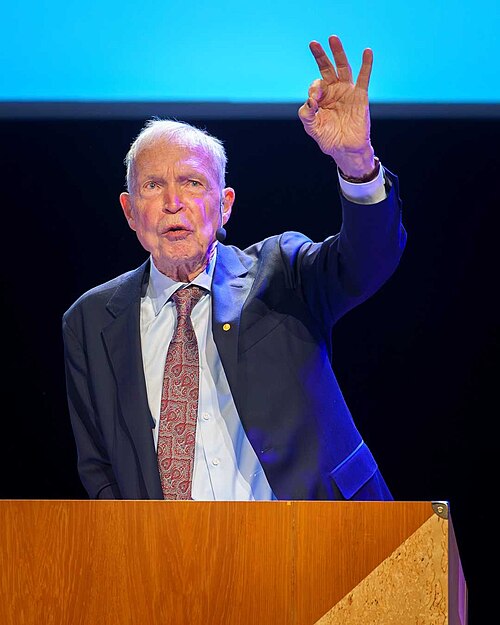
John Hopfield is an American physicist and Princeton professor emeritus who in 1982 introduced the Hopfield network, a neural network that stores memories and recalls them from partial clues. Hopfield shared the 2024 Nobel Prize in Physics with Geoffrey Hinton and remains a professor emeritus at Princeton University.
Last checked Nov 4, 2026 · 3 sources
- Now
 Princeton University (emeritus)Professor of Molecular Biology, Emeritus
- Born
 15 July 1933, Chicago, Illinois, United States
Experience
- 1997 to now
Princeton University
Professor of molecular biology, now emeritus
 1980 to 1997
California Institute of Technology
Professor of chemistry and biology
- 1964 to 1980
Princeton University
Professor of physics
 1961 to 1964
University of California, Berkeley
Physics faculty
Education

Cornell University
PhD in physics, 1958

Swarthmore College
BA in physics, 1954
What is John Hopfield doing now?
Hopfield is a professor emeritus at Princeton University, which was Hopfield's affiliation when the Nobel Prize in Physics was awarded in 2024. We found no report of a new role in 2026.source
What is Hopfield known for?
The Hopfield network
A network of connected units that settles into stored patterns, so it can recall a whole memory from a partial or noisy version.source In the Encyclopedia
Dense associative memory
A 2016 extension with Dmitry Krotov that lifts the original network's small memory limit.source In the Encyclopedia
Bridging physics and biology
Hopfield moved from solid-state physics to biology and neuroscience, and helped found Caltech's Computation and Neural Systems program.source In the Encyclopedia
Why does Hopfield matter?
The Hopfield network showed that a physical system of simple connected units can store and retrieve memories, linking physics, biology and computing. That idea fed directly into the neural network research behind modern AI.
How did Hopfield get here?
- 1958
Completed a PhD in physics at Cornell, then spent two years in the theory group at Bell Labs.source
- 1964
Joined Princeton's physics faculty after three years at UC Berkeley.source
- 1980
Moved to Caltech in chemistry and biology, and from 1981 to 1983 taught The Physics of Computation with Richard Feynman and Carver Mead.source
- 1982
Published the paper that introduced the Hopfield network, Hopfield's first paper in neuroscience.source
- 1986
Co-founded Caltech's Computation and Neural Systems PhD program.source
- 1997
Returned to Princeton, in molecular biology.source
- 2016
With Dmitry Krotov, extended Hopfield networks to store far more memories, known as dense associative memory.source
- 2024
Shared the Nobel Prize in Physics with Geoffrey Hinton.source
How can you learn from Hopfield for free?
- WatchNobel Prize lecture (2024)
Hopfield's 2024 Nobel lecture on physics and neural networks.
- PaperDense Associative Memory for Pattern Recognition
Krotov and Hopfield's modern take on associative memory.
Questions people ask about Hopfield
Why did John Hopfield win the Nobel Prize?
Hopfield shared the 2024 Nobel Prize in Physics with Geoffrey Hinton "for foundational discoveries and inventions that enable machine learning with artificial neural networks."source
What is a Hopfield network?
A neural network, introduced by Hopfield in 1982, that stores patterns and recalls a full stored pattern when given part of it, a model of associative memory.source
Where does John Hopfield work?
Hopfield is a professor emeritus at Princeton University, Hopfield's affiliation at the time of the 2024 Nobel Prize.source
Who has Hopfield worked with?
Learn the ideas behind this work
Want a full plan? The AI Roadmap has one for your role, free, counted in hours.