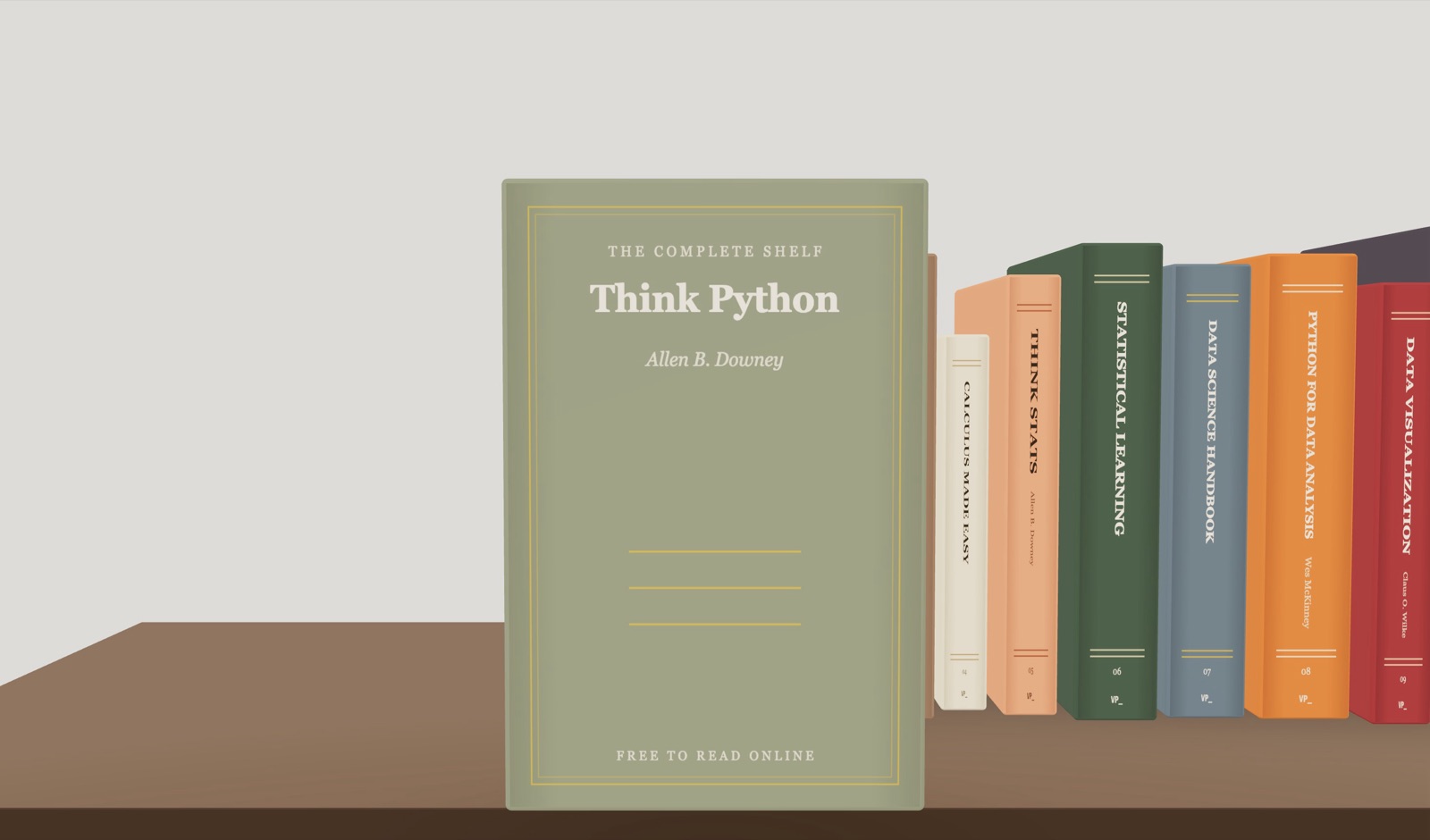
The Complete ShelfAn interactive 3D library
● 19 volumes · every one free to read
Nineteen books that take you from your first line of Python to AI safety, and every one of them is free to read at the publisher. Not free trials, not first chapters, and nothing pirated: these are books the authors and publishers put online themselves.
Drag, scroll or use the arrow keys to move along the shelf. Click a spine to pull the book out, then orbit and zoom it. Reviewed August 2026.
Every book on the shelf
- 01Think Python
Allen B. Downey · Python Programming for AI
The gentlest honest introduction to programming. Free online, and the one to start with if you have never written code.
- 02Mathematics for Machine Learning
Deisenroth, Faisal & Ong · Math for AI
Exactly the mathematics you need and nothing more: linear algebra, calculus, probability, aimed at machine learning.
- 03Linear Algebra
Jim Hefferon · Math for AI
A complete undergraduate linear algebra text, author-hosted and free, with full solutions.
- 04Calculus Made Easy
Silvanus P. Thompson · Math for AI
Written in 1910 and still the kindest calculus book ever published. Public domain via Project Gutenberg.
- 05Think Stats
Allen B. Downey · Statistics & Probability for AI
Statistics taught through Python code rather than proofs. Free online.
- 06An Introduction to Statistical Learning
James, Witten, Hastie, Tibshirani & Taylor · Intro to Machine Learning
The standard first ML text, now with a Python edition. Free PDF from the authors.
- 07Python Data Science Handbook
Jake VanderPlas · NumPy, Pandas & Visualization
NumPy, pandas, matplotlib and scikit-learn, as a reference you actually keep open. Free online.
- 08Python for Data Analysis
Wes McKinney · NumPy, Pandas & Visualization
Written by the creator of pandas. The third edition is open access on his own site.
- 09Fundamentals of Data Visualization
Claus O. Wilke · NumPy, Pandas & Visualization
How to make a chart that tells the truth. Thirty chapters, free, and beautifully made.
- 10Pattern Recognition and Machine Learning
Christopher M. Bishop · Intro to Machine Learning
The classical ML reference, released free as a PDF by Microsoft Research. Pre-deep-learning, still rigorous.
- 11Approaching (Almost) Any Machine Learning Problem
Abhishek Thakur · Scikit-Learn & Hands-On ML
A practitioner's playbook from a four-time Kaggle grandmaster. Free PDF on the author's own GitHub.
- 12Dive into Deep Learning
Zhang, Lipton, Li & Smola · Neural Networks & Deep Learning
Interactive, runnable, and maintained. Every concept comes with working code in multiple frameworks.
- 13Deep Learning
Goodfellow, Bengio & Courville · profile · Neural Networks & Deep Learning
The foundational textbook of the field, free to read online. Dense, and worth it.
- 14Neural Networks and Deep Learning
Michael Nielsen · Neural Networks & Deep Learning
Builds a working network from nothing, one idea at a time. Still the clearest first pass at backpropagation.
- 15Speech and Language Processing
Dan Jurafsky & James H. Martin · NLP & Text Processing
The NLP reference, updated as a free draft for decades. Now covers transformers and LLMs.
- 16Machine Learning Engineering
Andriy Burkov · MLOps & Deploying AI
What happens after the model works: data, deployment, monitoring, drift. Read free online.
- 17Reinforcement Learning: An Introduction
Richard S. Sutton & Andrew G. Barto · Reinforcement Learning
The RL book. Second edition free from Sutton's own site.
- 18The RLHF Book
Nathan Lambert · profile · Reinforcement Learning
How preference tuning actually works, written as the technique matured. Free online.
- 19AI Safety, Ethics and Society
Dan Hendrycks · AI Safety & Responsible AI
A structured course in what can go wrong and why, from the Center for AI Safety. Free book, PDF and video.
How the shelf is built
Every volume is generated geometry: a rounded case, an inset paper block, and a foil motif stamped a fraction of a millimetre proud of the cloth so it catches the key light. There are no model files and no textures, so the whole library ships as code you can diff.
Proportions are authored per book rather than randomised, because a shelf only reads as real when the volumes disagree with each other. The thin cloth pamphlet next to the thick reference is the entire effect.
Browsing rails the camera along one axis at a fixed height. Letting you orbit the whole run made the spines unreadable from every angle worth looking at, so the rail is a constraint on purpose. Orbit, pan and zoom are handed over once a book is out.
The shelf is measured in metres at roughly 1:1 scale, so the tall references stand about 25cm and the pamphlets about 20cm, the way they would on a real shelf.
The interaction design of this shelf is inspired by The Complete Shelf by Mint, re-implemented from scratch as procedural geometry. Every source this site learns from is named on the credits and inspiration page.