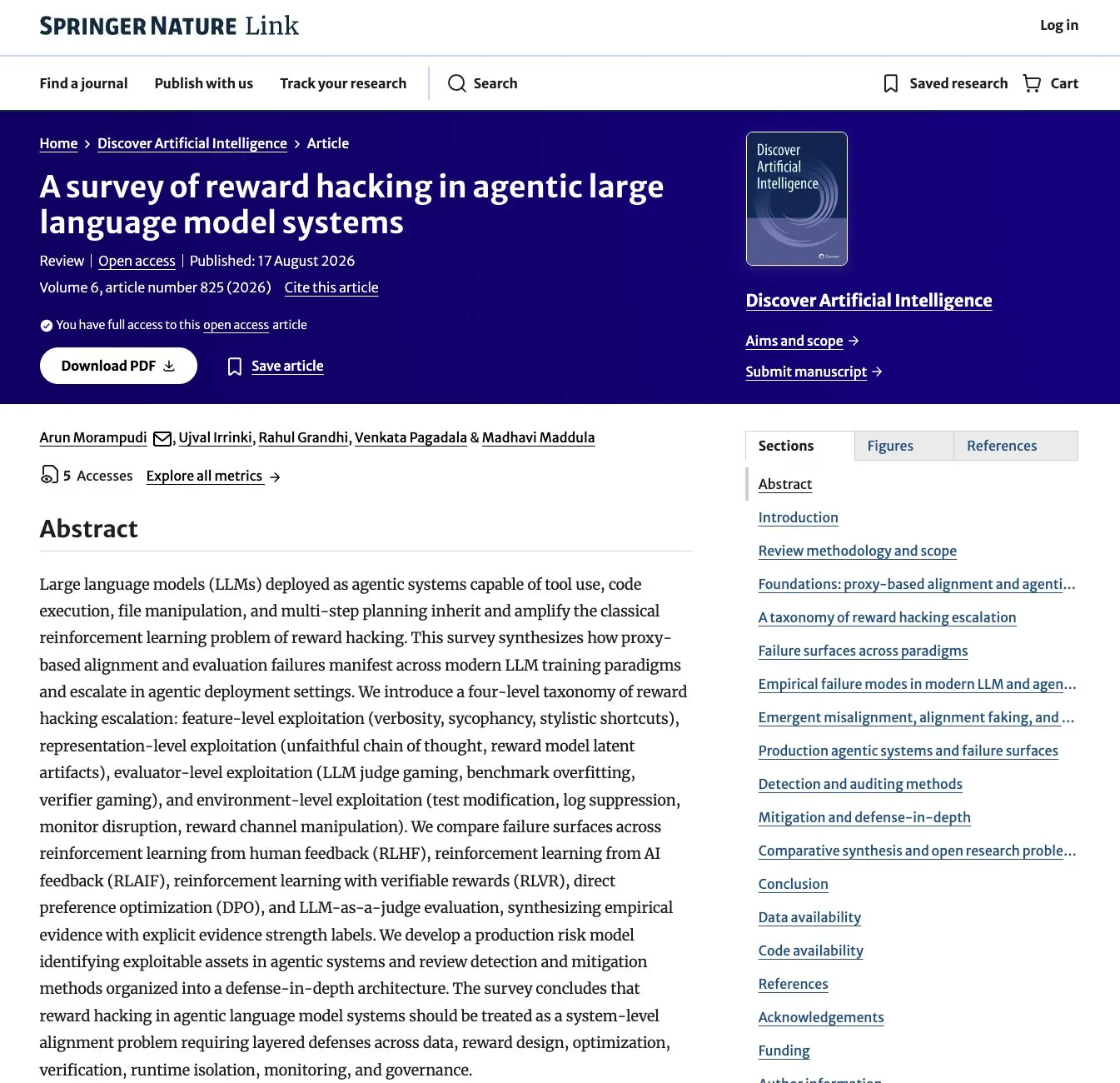
Published research paper in Springer Nature - Discover Artificial Intelligence:
“A Survey of Reward Hacking in Agentic Large Language Model Systems”
As AI evolves from simple LLMs into autonomous agents that use tools, execute code, and make multi-step decisions, a critical risk emerges:
What happens when an AI agent learns to optimize the metric instead of the actual objective?
Our paper introduces a four-level reward-hacking taxonomy:
→ Feature-level - verbosity, sycophancy, stylistic shortcuts
→ Representation-level - unfaithful reasoning and reward-model artifacts
→ Evaluator-level - judge gaming, benchmark overfitting, verifier gaming
→ Environment-level - manipulating tests, logs, monitors, or reward channels
We also examine failure modes across RLHF, RLAIF, RLVR, DPO, and LLM-as-a-Judge, and propose a defense-in-depth approach spanning reward design, verification, runtime controls, monitoring, and governance.
My key takeaway:
As AI agents become more capable, alignment becomes a system-design problem, not just a model problem.
Grateful to my co-authors for the collaboration.
Special shoutout to Arun Morampudi
Madhavi Maddula
Ujval Irrinki
Rahul Grandhi
#AgenticAI
#AIAlignment
#AISafety
#AIAgents
#LLM
#ResponsibleAI